
The Invisible Liability
Every year, global manufacturers spend millions on a "Data Vacuum."
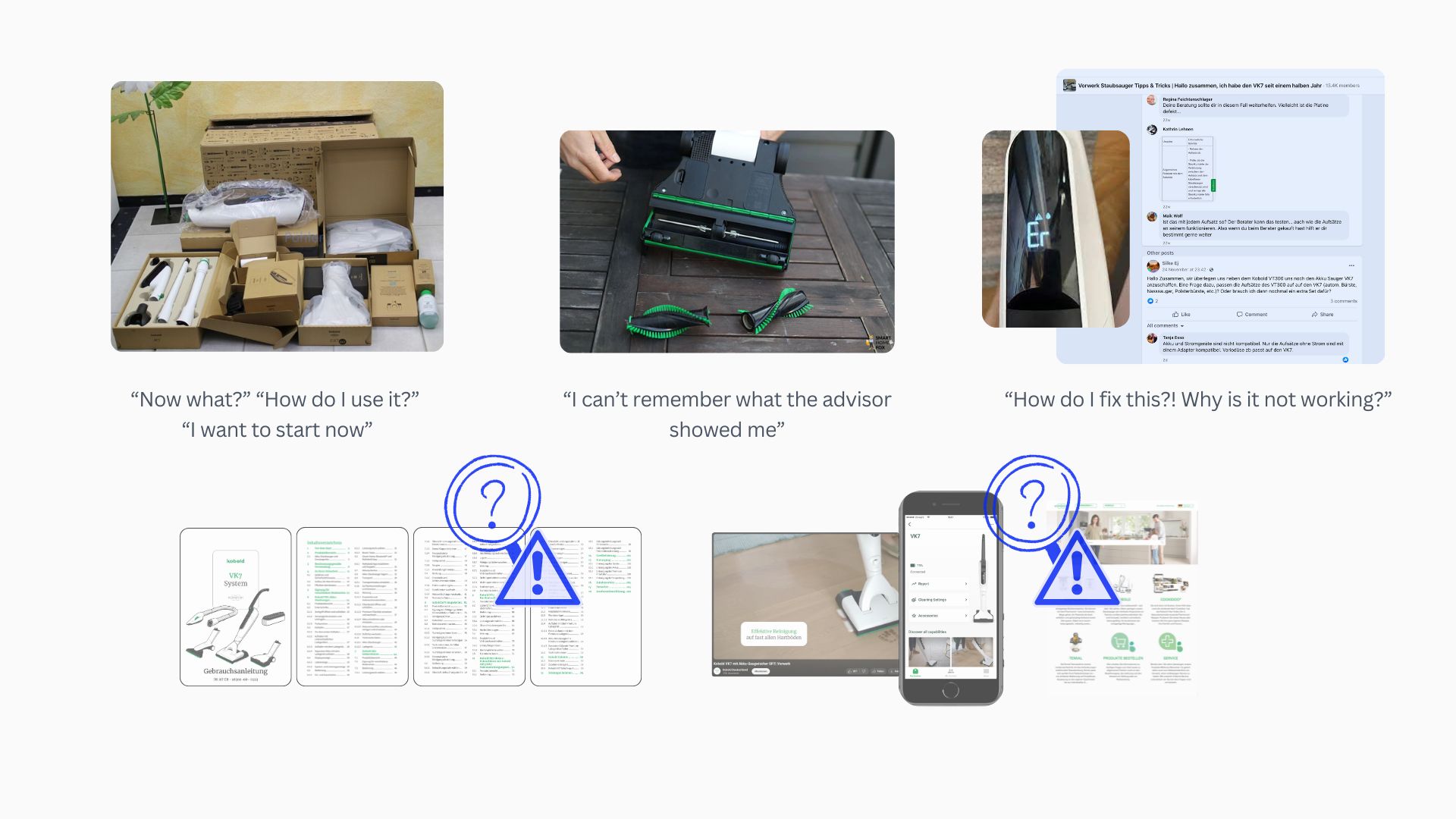
They ship premium products accompanied by static paper manuals and a library of YouTube videos. They hope their customers will watch, they hope their distributors won't be overwhelmed, and they hope the product is used correctly.
Hope is not an operational strategy.
In reality, the "Instruction Gap"—the distance between what a product can do and what a user knows how to do—is a multi-million dollar liability. It manifests as unsatisfactory reviews, premature warranty claims, and thousands of calls to support centers. Even for an intuitive brand like Vorwerk, this gap was the final frontier of the customer experience.
Moving from Optimistic to Deterministic
Most companies' approaches are optimistic: "We made a video, surely they will watch it."
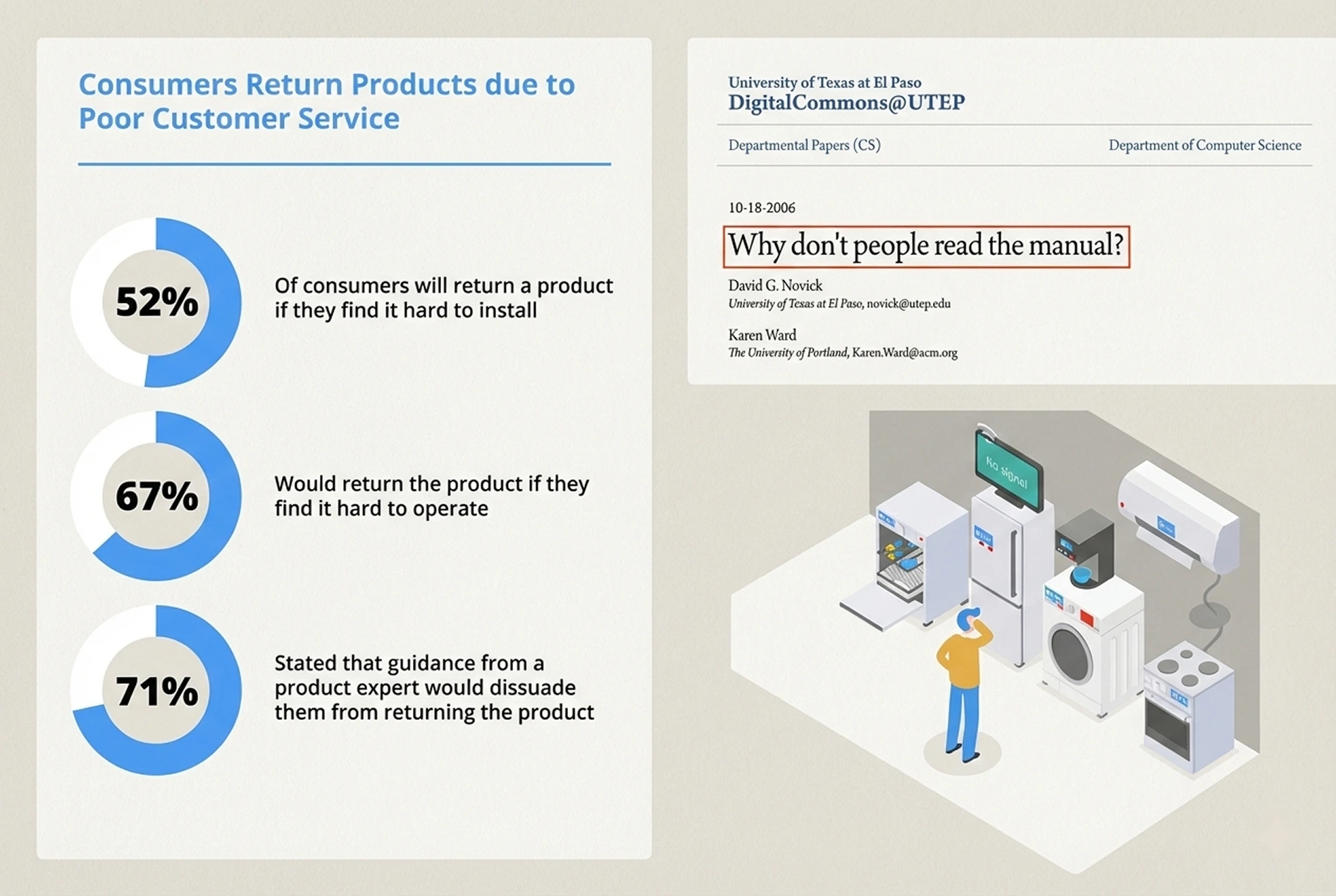
At the same time, we're living through a fundamental shift in how people find answers. Most people (81%) genuinely want to help themselves, but the mental load is too high.
Search journeys that used to last ten minutes now end in ten seconds with an AI summary. YouTube, while useful, has become a "distraction engine" where your product is buried between a pre-roll ad and a recommended video for something else.
Vorwerk realized this early and moved to deterministic approach.
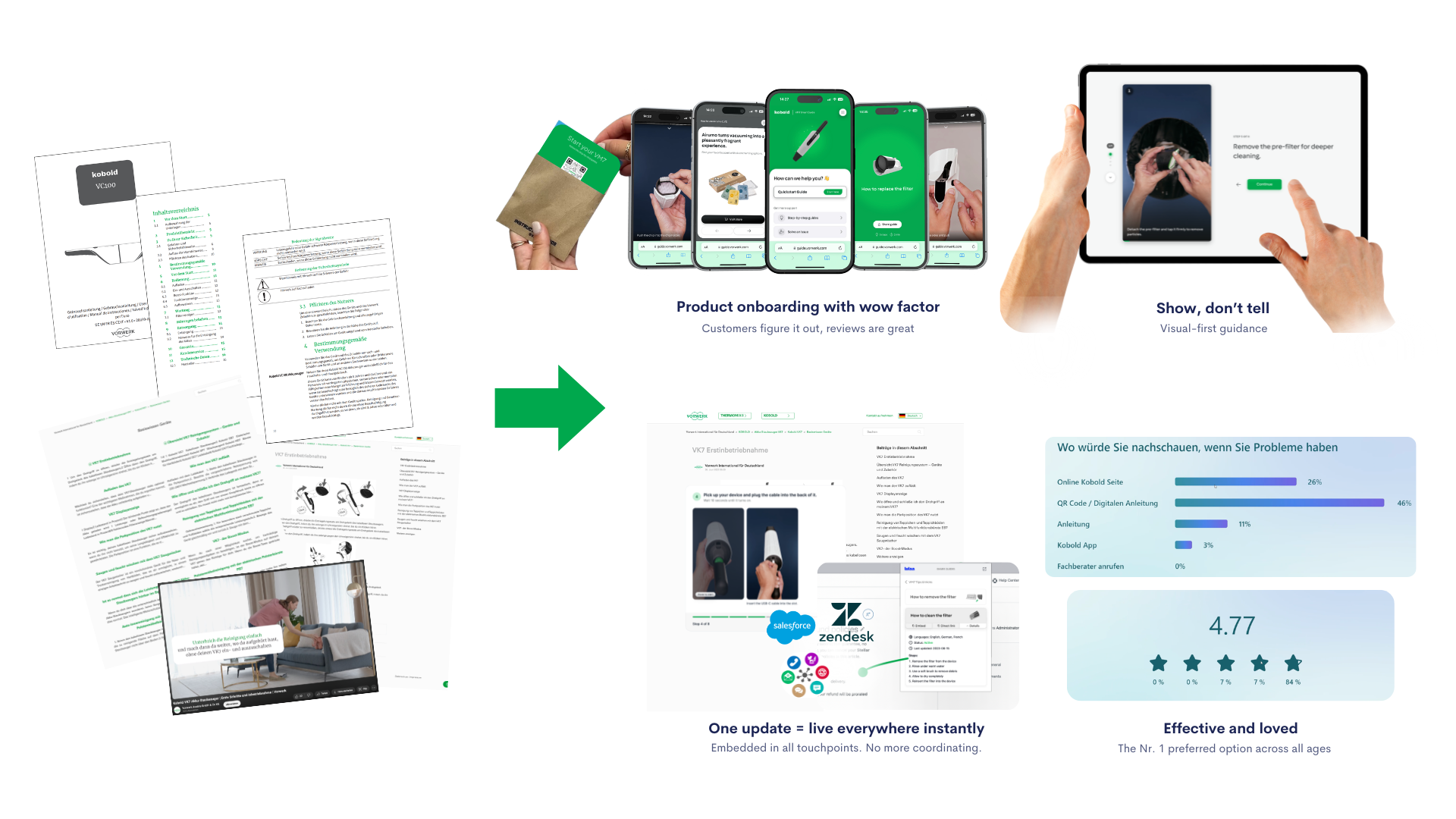
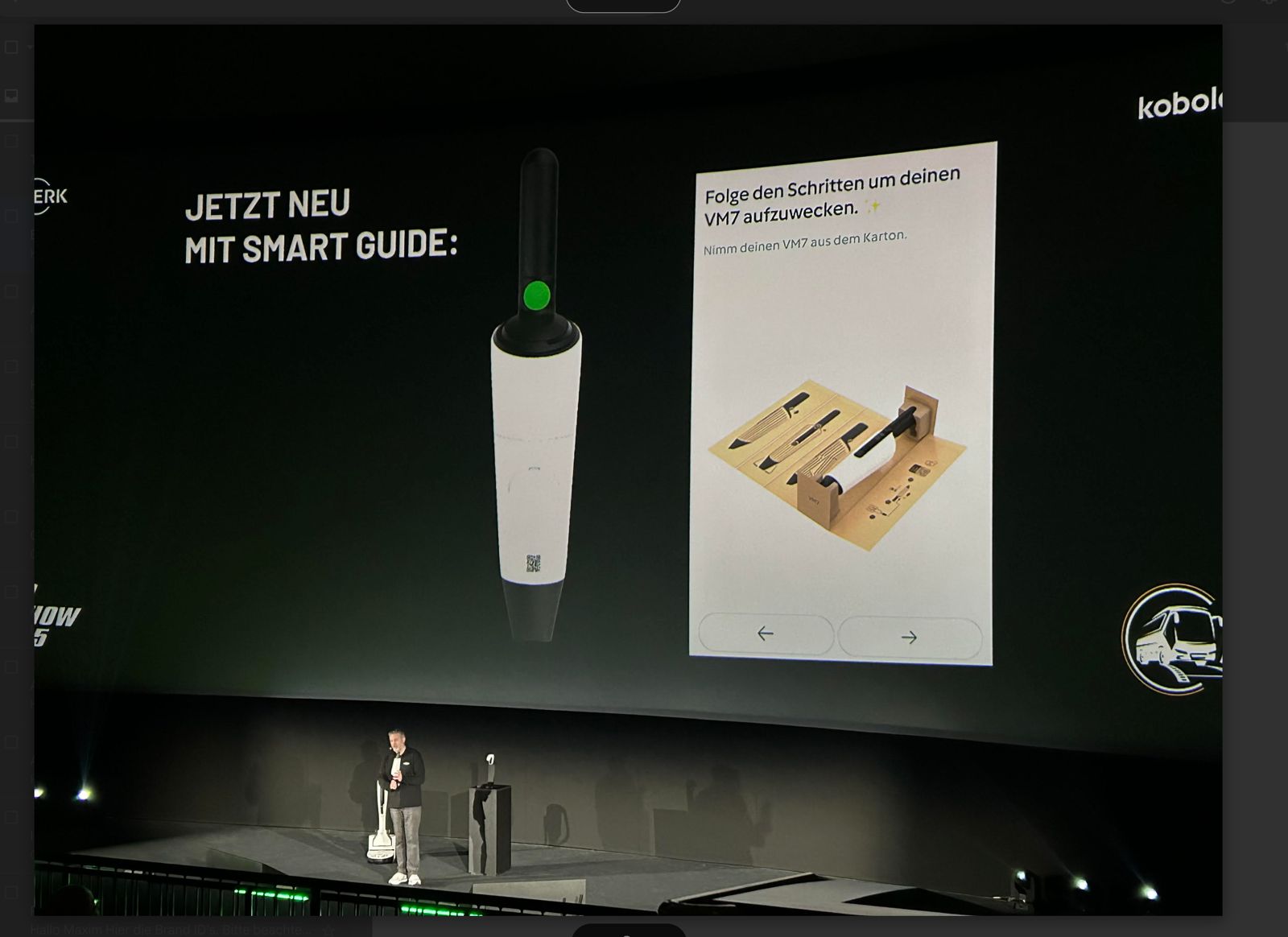
Instead of a menu with various videos, the pilot introduced an Intelligent Guidance Layer. By placing Lulaa ("the expert") exactly one scan away from the physical task, Vorwerk removed the need for the user to diagnose or figure out what they need to watch.
This is the shift from search-based to point-of-need guidance.
Intuitive Doesn’t Mean Effortless
The internal consensus for the VM7 was that the product practically didn’t need a manual. In a Direct-to-Consumer (DTC) world, "plug-and-play" is the goal.
But user testing showed that even intuitive products still trigger "Instruction Gaps."
These gaps aren't just singular problems but often inevitable moments throughout a product’s lifecycle. Take the common support query: "The suction is weak."
It’s rarely a motor failure. In most cases, it’s a filter that needs cleaning or a minor blockage. It's just a fundamental reality of the category, but the frustration lies in the specifics. How do you tap out this specific filter without a cloud of dust in your kitchen? Where is the exact latch for this model to clear a clog?
Every brand has a different "click" or a unique mechanical cue. If customers can't find it in seconds, they stop seeing a premium device and start seeing a broken appliance.
Lulaa ensured that "simple" stayed simple. By serving the exact visual cues for these recurring maintenance moments, Vorwerk allowed a potential warranty claim to become a simple, 10-second fix in the kitchen.
The Economics of Clarity: ROI in 8 Months
In an era where most enterprise "AI pilots" struggle to show real impact, the VM7 launch was an outlier. Lulaa reached ROI in just eight months.
The ROI came from three specific, high-friction cost centers:
- The "Self-Funding" Launch: Replacing a premium, multi-language paper manual saves roughly 25 to 35 cents per unit in combined printing and logistics costs. At a scale of 150,000 units, Vorwerk eliminated over 22 metric tons of paper from their supply chain. This immediate cost reduction acted as a down payment on the technology before the first product was even unboxed.
- The Proactive Support Shield: Level 1 support tickets cost around €5. Lulaa drove over 50,000 guided successes where users completed their setup or maintenance tasks without human intervention. The system also shielded the DACH team from thousands of expensive Level 2 escalations that typically cost up to €15 each.
- The Avoided Headcount: A major launch usually requires hiring additional support staff. Vorwerk managed the entire rollout with their existing team, keeping operational costs stable while the product took off.
Scaling Expertise to the Advisor Network
Vorwerk’s strength lies in its network of advisors. But as products become more feature-rich, they often find themselves functioning as "Human Manuals."
Even the best demonstration can leave a customer with mental load once they get the product home. With Lulaa, the advisor could offer a sense of relief: "You don't have to worry about remembering everything we just went over. You can see exactly how everything is done with the QR code at home."
The system also became a vital reference tool for the advisors themselves, allowing them to brush up on specific features right before a demo. The feedback during the launch was overwhelmingly positive as a result:
"It's like having a personal Vorwerk expert walk you through everything."
Aligning the Enterprise: Single Source of Truth
Hardware launches are notoriously siloed. Product teams build features, CX teams design journeys, and Support teams inherit the problems.
Usually, this is where projects stall in a crossfire of different priorities, but Vorwerk operated with a "just do it" mentality. Leadership gave us the air cover to move fast, test our assumptions, and iterate in real-time.
For the VM7 launch, Lulaa acted as the "Stakeholder Bridge:"
- CX saw the "First-Hour" journey secured.
- Product saw their engineering explained clearly.
- Support saw a proactive shield against Level 1 and 2 tickets.
- Marketing didn't have to hire and brief an external agency to produce content.
By centering the collaboration on a single, visual "Guidance Layer," we removed the usual friction of internal politics.
A New Standard of Ownership
The success of the VM7 launch proves that the era of "Static Instructions" is ending. Consumers no longer have the patience for the search bar, and manufacturers can no longer afford the "Data Vacuum" of unmonitored YouTube videos and paper manuals.
By turning a static requirement into an Intelligent Guidance Layer, Vorwerk didn't just save money on support tickets; they claimed ownership of the most critical moment in the product lifecycle: the first interaction.
This isn't just about vacuums or appliances. It's about a fundamental shift in how humans interact with the physical world. As hardware gets smarter, the software that guides us must keep pace.